

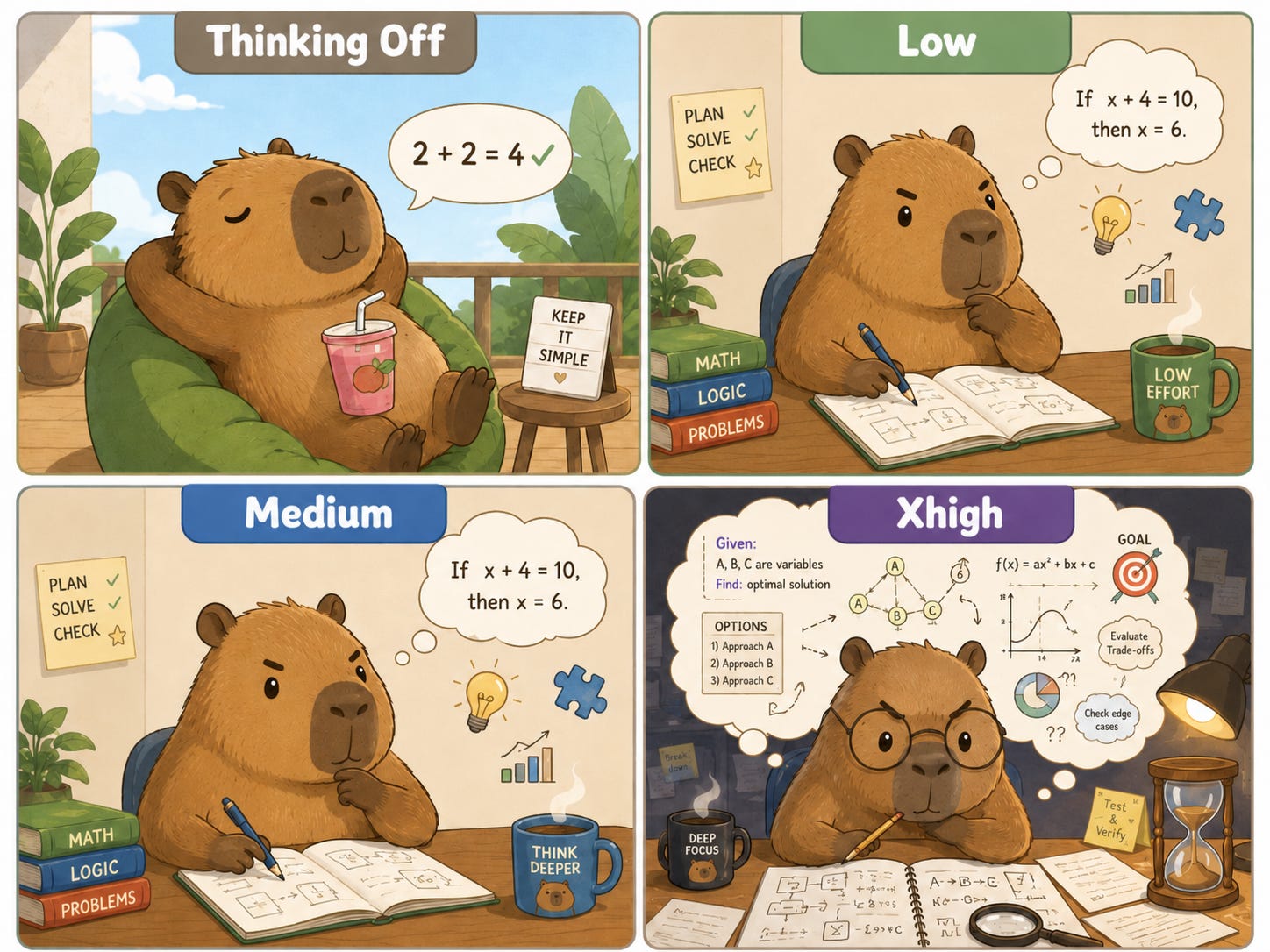
In a previous article, I benchmarked Qwen3.8 27B using its highest reasoning effort, xhigh. That shows the model at its best, but it does not tell us whether xhigh is the most efficient way to run it. Qwen3.8 27B also supports medium and low reasoning efforts, while thinking can be disabled completely.

In this article, I compare these four configurations to see how reasoning effort affects both accuracy and token usage. I ran a large number of tasks and generated hundreds of millions of tokens. For each mode, I measure how well Qwen3.8 performs and how many tokens it uses to get there.
How much accuracy do we gain by letting Qwen3.8 think more, and how many extra tokens does that cost?
xhigh should give the best results, but it may also generate much longer reasoning traces. If medium or low can retain most of the accuracy while using significantly fewer tokens, they may be better choices in practice.
This is especially relevant for local inference. More reasoning tokens mean more generation time, more compute, and higher memory consumption. A small improvement in accuracy may not be worth it if the model requires two or three times as many tokens to achieve it.
I will first explain how Qwen3.8 reasoning effort works, how low, medium, and xhigh are implemented in the chat template, and how to set them correctly with vLLM and llama.cpp. I will then compare their accuracy and token usage across several benchmarks, before briefly putting the results in context against Qwen3.6 and Muse Glimmer.
Acknowledgments
Verda provided the RTX Pro 6000s to run the experiments described in this article.
Verda is a full-stack AI cloud, built for high-performance inference, training, and agentic workloads, with data privacy and sustainability at its core.
You can check them out here. There is a $50 coupon that you can redeem in your Verda account, after provisioning it with $5, to try their GPUs.
Coupon code:
KAITCHUP-50Follow these instructions to redeem it.
Note: I don’t receive any form of compensation from Verda, or any usage information, related to this coupon.
Note: These experiments focus on non-agentic tasks, where each prompt is evaluated as a standalone problem. I am testing long-horizon agentic coding separately, and the runs are almost complete, but there is still a large amount of data to analyze and verify. I plan to cover those results in a separate article, probably next week.
How Qwen3.8 Reasoning Effort Works
Qwen3.8 supports three reasoning_effort values: low, medium, and xhigh. Thinking can also be disabled with enable_thinking=false. The goal of these settings is to control how much reasoning the model does before producing its final answer. low asks the model to keep its reasoning short and focused, while xhigh encourages more careful and thorough reasoning. medium sits between the two.