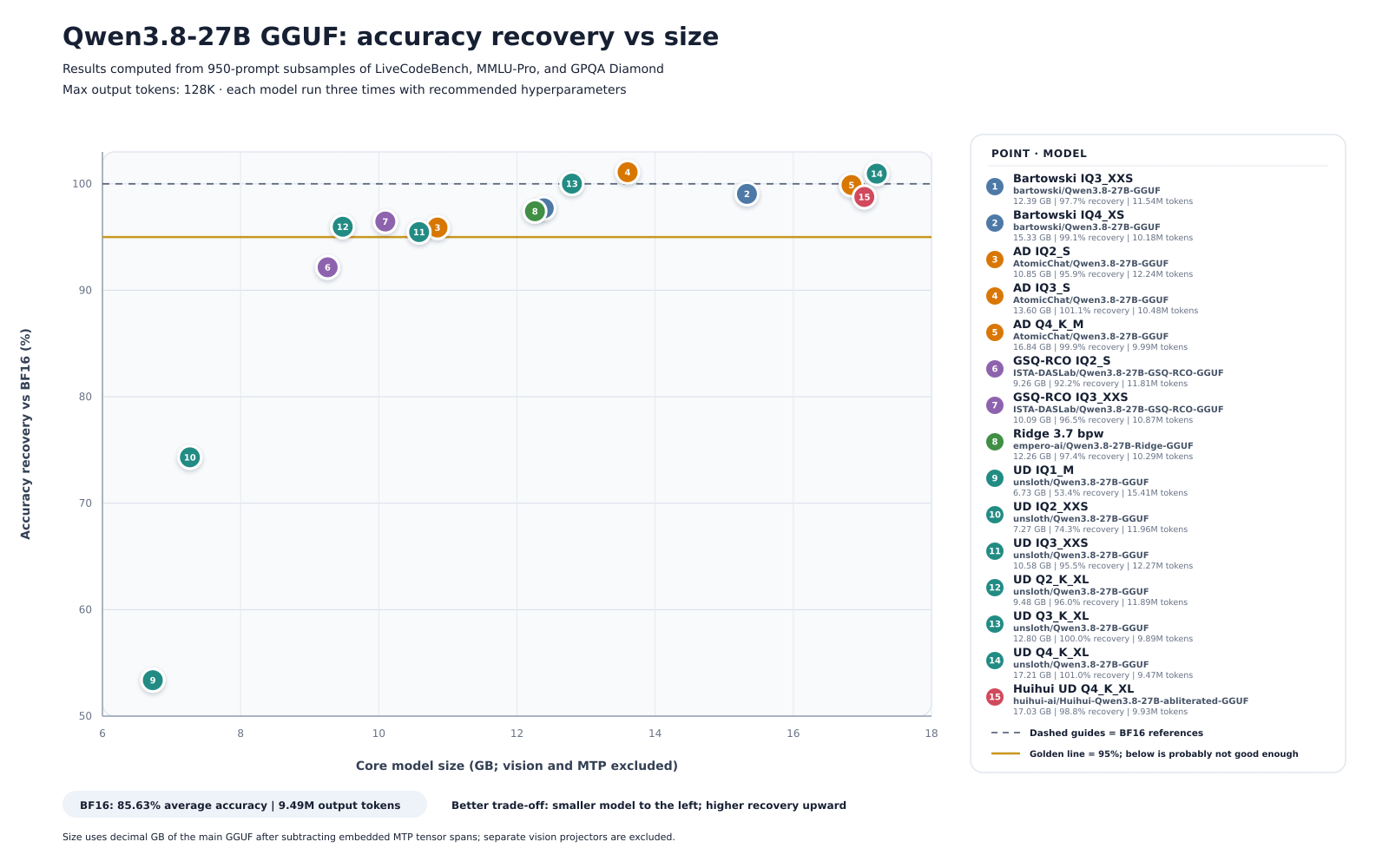
Qwen3.8 27B is one of the best models for local AI right now. And for most local LLM users, local AI is experienced through the GGUF lens.

But how good are these GGUFs, actually?
We don’t have a clear answer. This is a problem I’ve discussed many times before.
Metrics such as KLD and PPL are useful for measuring how much a quantized model deviates from the original model, but they are not anchored in the accuracy space. A KLD or PPL value may indicate that one quantization is worse than another, but it cannot tell you when the degradation becomes large enough that the model stops being useful.
By design, these metrics cannot answer that question.
The only reliable way around this is the expensive one: run real benchmarks and generate millions of tokens.
So that’s what I did.
For this article, I generated more than 150 million tokens, requiring roughly 8 days of continuous benchmarking on an NVIDIA RTX Pro 6000.
I evaluated 15 GGUF versions of Qwen3.8 27B, ranging from Q4 down to Q1, produced by several different providers.
The main goal was to measure two things: accuracy and token efficiency. In other words, how low can you go on a 12 GB, 16 GB, or 24 GB GPU before the accuracy loss becomes significant, or before the model starts generating substantially more tokens to solve the same tasks?
Acknowledgments
Verda provided the RTX Pro 6000s to run the experiments described in this article.
Verda is a full-stack AI cloud, built for high-performance inference, training, and agentic workloads, with data privacy and sustainability at its core.
You can check them out here. There is a $50 coupon that you can redeem in your Verda account, after provisioning it with $5, to try their GPUs.
Coupon code:
KAITCHUP-50Follow these instructions to redeem it.
Note: I don’t receive any form of compensation from Verda, or any usage information, related to this coupon.
List of the evaluated Qwen3.8 GGUF models
Note: The sizes listed below exclude the MTP and vision layers.
Qwen3.8-27B-UD-Q4_K_XL.gguf: 17.2 GB
Qwen3.8-27B-UD-Q3_K_XL.gguf: 12.8 GB
Qwen3.8-27B-UD-IQ3_XXS.gguf: 10.6 GB
Qwen3.8-27B-UD-Q2_K_XL.gguf: 9.5 GB
Qwen3.8-27B-UD-IQ2_XXS.gguf: 7.3 GB
Qwen3.8-27B-UD-IQ1_M.gguf: 6.7 GB
huihui-ai/Huihui-Qwen3.8-27B-abliterated-GGUF
Huihui-Qwen3.8-27B-abliterated-UD-Q4_K_XL.gguf: 17 GB
Qwen3.8-27B-AD-Q4_K_M.gguf: 16.8 GB
Qwen3.8-27B-AD-IQ3_S.gguf: 13.6 GB
Qwen3.8-27B-AD-IQ2_S.gguf: 10.8 GB
Qwen3.8-27B-IQ4_XS.gguf: 15.3 GB
Qwen3.8-27B-IQ3_XXS.gguf: 12.4 GB
empero-ai/Qwen3.8-27B-Ridge-GGUF
Qwen3.8-27B-Ridge-3.7bpw.gguf: 12.3 GB
ISTA-DASLab/Qwen3.8-27B-GSQ-RCO-GGUF
Qwen3.8-27B-GSQ-RCO-IQ3_XXS.gguf: 10.1 GB
Qwen3.8-27B-GSQ-RCO-IQ2_S.gguf: 9.3 GB
Qwen3.8 27B GGUF Benchmark Methodology and Evaluation Setup
Each GGUF evaluation took roughly 10~15 hours on an NVIDIA RTX Pro 6000, so evaluating every available quantization was simply not practical.
All GGUFs were evaluated using the exact same set of 950 prompts, subsampled from MMLU-Pro, LiveCodeBench, and GPQA Diamond.
I used the inference hyperparameters recommended by Qwen rather than setting the temperature to 0. Greedy decoding would have made the results easier to compare, but it would also have produced significantly lower accuracy scores and substantially more generated tokens, increasing the overall evaluation cost. Note: That said, with a much larger budget, I think temperature = 0 is a very good setting for evaluating quantization damage. At temperature 0, even the BF16 model performs worse on these tasks, but it remains relatively stable and does not collapse. Poorly quantized models, on the other hand, may degrade much more severely under the same conditions. In that sense, greedy decoding can act as a harsher stress test, making quantization-induced degradation easier to expose.
The trade-off is that sampling introduces nondeterminism and fairly high score variance. To compensate for this, I ran each evaluation three times and averaged the results.
All GGUF models were served through a llama.cpp server. I set the maximum output length to 128K tokens and used low thinking mode. This still allows the model to generate sufficiently long reasoning traces to expose quantization damage, while keeping the total evaluation cost manageable.
How to read these results
The goal of this evaluation is not to produce a definitive ranking of GGUFs. Doing that properly across this many quantizations, with enough repetitions to confidently distinguish small differences, would easily cost $10,000+.
Instead, the goal is to identify which GGUFs show no clear signs of significant degradation compared with the original BF16 model.
For that purpose, I use a simple threshold: if a GGUF recovers more than 95% of the BF16 model’s accuracy, I consider it good enough.
In practice, a GGUF can occasionally score higher than the original BF16 model, but this should not be interpreted as the quantized model being better. It is simply a consequence of sampling and benchmark variance.
Below 95% accuracy recovery, I consider the degradation too large. At that point, you are probably better off using a smaller model at a healthier quantization level rather than forcing a heavily quantized 27B model to fit on your GPU.
There is also an important limitation to keep in mind.
All the benchmarks used here are single-turn, non-agentic tasks. Even though this evaluation is already expensive, it is still far too cheap to reliably tell us how well a given GGUF will perform on long-running agentic workloads.
For tasks such as agentic coding, even a seemingly small 1% accuracy loss can compound across many successive steps and tool calls. A model that looks nearly identical to BF16 on a single-turn benchmark may behave quite differently over a long agent trajectory.
If agentic workloads are your main use case, I would interpret these results asymmetrically: models near or below the 95% threshold are strong candidates to avoid, while models clearly above it should only be considered potentially good enough. How much quantization you can tolerate will ultimately depend on the length and complexity of your agentic tasks.
Note: I’m running more evaluations for UD-Q2_K_XL and UD-Q4_K_XL for agentic coding. It will take at least a week.
Qwen3.8 27B GGUFs: Token Efficiency and Accuracy
Below, I first present accuracy and then token efficiency before discussing the results together, because, as we will see, token efficiency is strongly correlated with accuracy degradation.
Accuracy