In this edition of The Weekly Kaitchup, let’s discuss Nemotron 3 Super, NVIDIA’s new flagship model with 120 billion parameters.
The Kaitchup – AI on a Budget is a reader-supported publication. To receive new posts and support my work, consider becoming a free or paid subscriber.
The Nemotron 3 series launched a few months ago with Nano, a 30B-parameter model, which I covered here:
Although Super was only officially released yesterday, NVIDIA had already granted early preview access to a number of companies and researchers. I don’t know how long that access window lasted, but the practical result is that we already have plenty of feedback, and many frameworks already support the model despite its highly unusual architecture.
Nemotron 3 Super’s Neural Architecture
Nemotron 3 Super is an MoE model built on a hybrid Mamba2–full-attention architecture. Don’t confuse it with Qwen3.5’s linear attention, as many people do: Gated DeltaNet and Mamba-2 are fundamentally different approaches.
More specifically, Nemotron 3 Super is structured as an 88-layer hybrid stack that interleaves Mamba-2 layers, LatentMoE layers, and strategically placed attention layers.
At a high level, you can think of it as a repeating pattern designed to preserve the global-recall benefits of attention while shifting most sequence processing into Mamba blocks, which use constant-size state during generation (like gated deltanet) instead of only relying on a KV cache that grows with sequence length, as in standard attention.
Pure attention remains strong for precise token-to-token association, but it becomes expensive as context grows. Pure state-space models improve scaling behavior, yet can give up some of that sharp retrieval behavior.
That does not mean there is no KV cache at all. There is one, but it’s very small:
KV Cache Math
With 8 attention layers, 2 KV heads, and head-dim 128, the sequence-growing KV cache comes out to:
For comparison, Qwen3.5-122B-A10B has 12 full-attention layers, head-dim 256, and works out to 24,576 bytes/token in BF16 for the attention KV term:
1M tokens → 22.89 GiB 262k tokens → 6.00 GiB
So on the sequence-scaled KV cache alone, Qwen3.5-122B is about 3x heavier than Nemotron 3 Super.
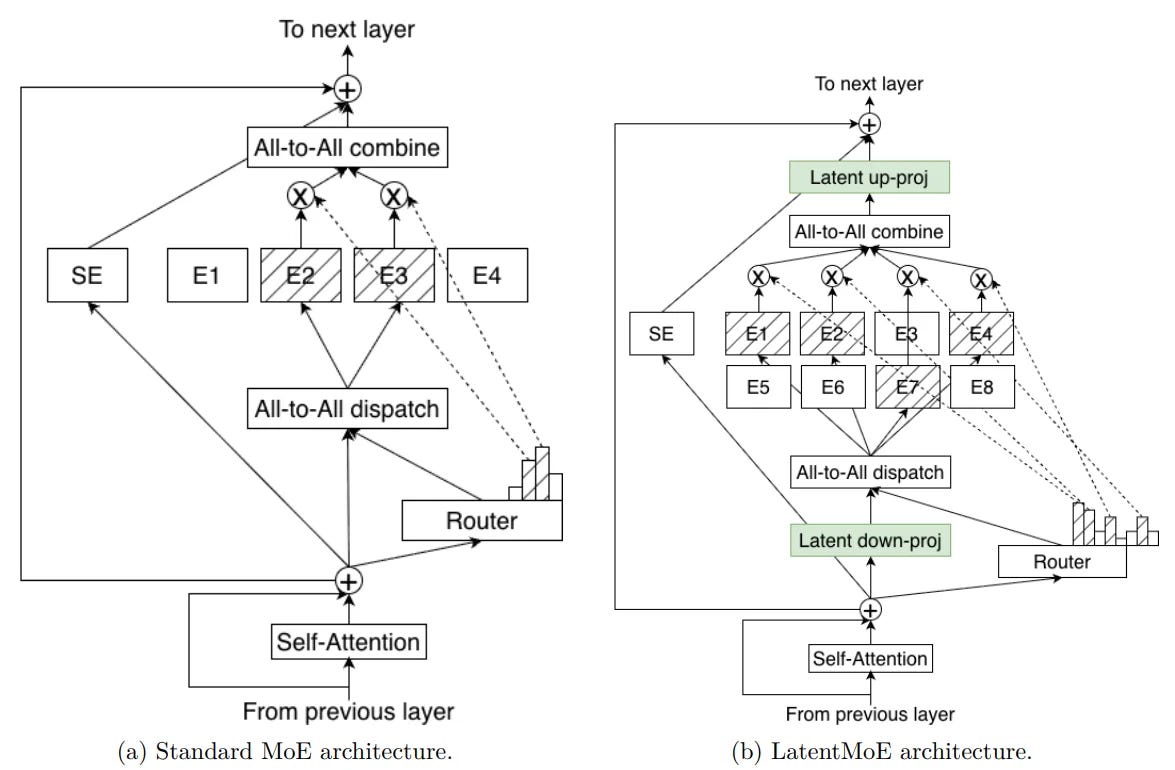
Nemotron 3 Super also introduces a LatentMoE, which may be the most important innovation in this model.
In a standard MoE, like the Nano version used, tokens are routed to experts in the full hidden dimension. Super compresses tokens into a lower-dimensional latent space before routing and expert computation, then projects them back afterward.
This reduces routed parameter loads and all-to-all communication by a factor proportional to the original hidden size divided by the latent size, and NVIDIA uses those savings to increase both the number of experts and the number of active experts at roughly constant inference cost. The model uses 512 experts per layer, top-22 expert activation (against 8 for Qwen3.5 122B), and a latent size of 1024.
Pre-training with NVFP4
For pre-training, they used 25 trillion tokens with extra emphasis on reasoning and coding. The technical report adds that pre-training was split into two phases, with the first 20 trillion tokens focused on broad coverage and the final 5 trillion on higher-quality data and benchmark accuracy. Pre-training was done in 4-bit, using the NVFP4 format.
NVIDIA also describes a dedicated long-context extension phase at the end of pre-training, including continued pre-training at 1M tokens and then alternating training at 1M and 4K context lengths. So, the model has a native max context length of 1M tokens. And since the KV cache is tiny, it’s actually usable (7 GB for 1M tokens in the KV cache).
After pre-training, the model goes through supervised fine-tuning on roughly 7 million samples, drawn from a broader 40 million-sample post-training corpus covering reasoning, coding, safety, instruction following, and multi-step agent tasks. Then there is reinforcement learning across 21 environments and 37 RL datasets, with about 1.2 million environment rollouts according to the launch post.
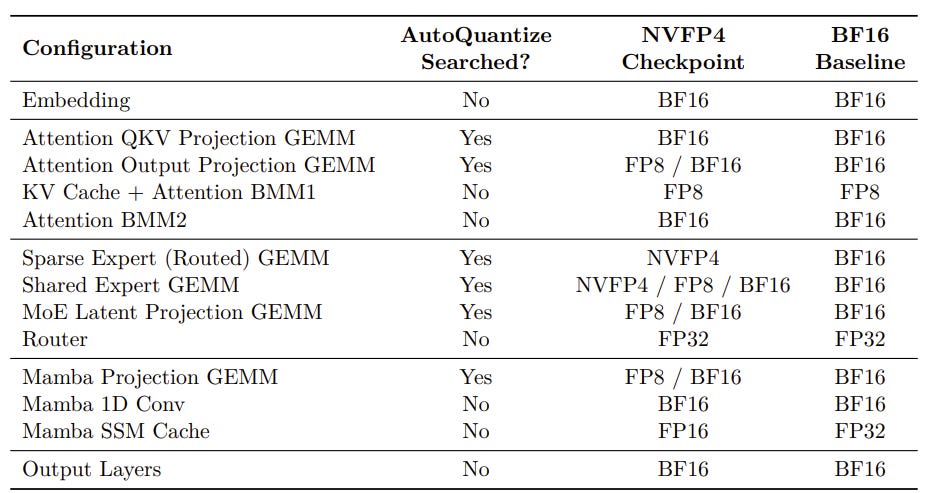
The NVFP4 checkpoint they released is not full NVFP4:
Mamba + Attention remain at higher precision (8~16-bit), along with the latent projections, router, embeddings and output layers.
It may look like most of the model is not NVFP4. Yet, since most of the model’s parameters are in the experts, the model is indeed mostly NVFP4:
Is Nemotron 3 Super a Good Model?
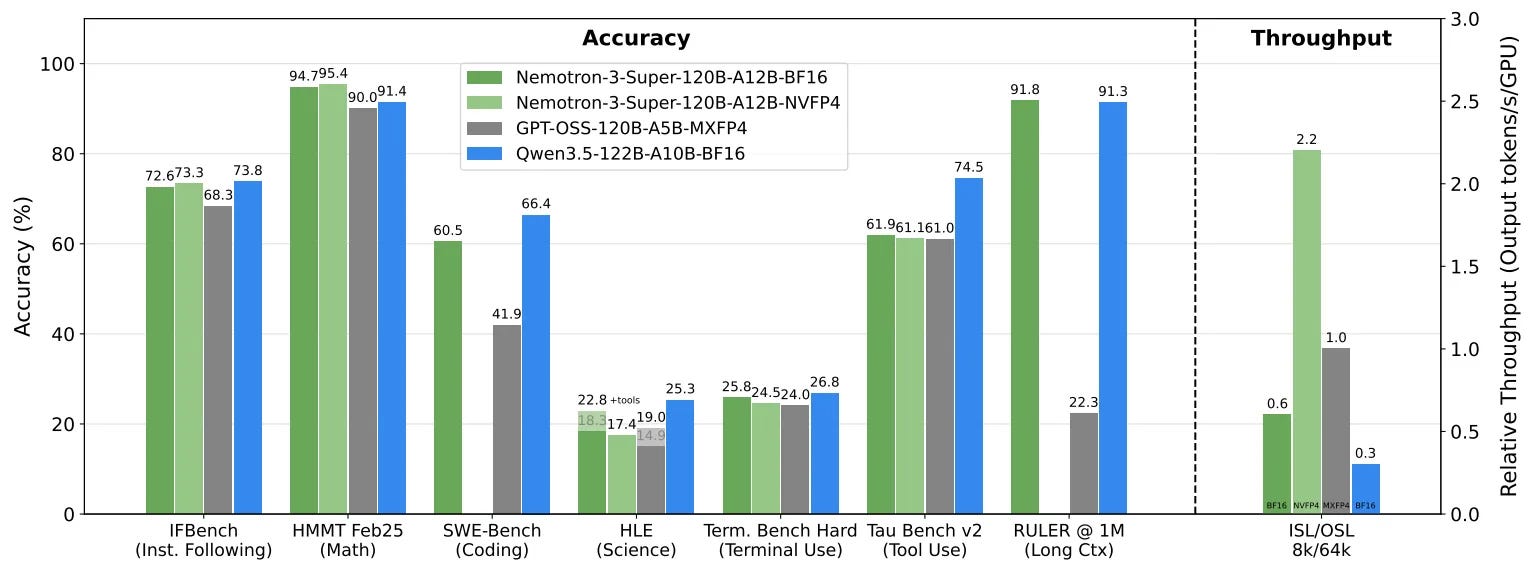
Yes. According to the community’s feedback and benchmarks, it performs closely to Qwen3.5 122B, it’s most natural “competitor”:
That said, I’m not yet convinced this model will see broad adoption. Most of the early evaluations released once NVIDIA gave the green light emphasize its efficiency, and that is clearly one of its main strengths. Still, a few caveats are worth keeping in mind:
You can often reach similar, and sometimes better, accuracy with a much smaller model such as Qwen3.5 27B. Most of the evaluations I saw don’t include a comparison with this model.
Qwen3.5 and other models used for comparison can also be quantized to NVFP4, which makes the comparison more complicated than some early charts suggest. I’ve seen many plots online comparing Nemotron 3 Super in NVFP4’s speed against full-BF16 models on B200, which is not really an apples-to-apples comparison. And as we saw yesterday, careful NVFP4 post-training quantization can preserve Qwen3.5’s accuracy surprisingly well.
Where Nemotron 3 Super may prove much more compelling, although we still need stronger real-world evidence, is in areas like:
Tasks that require very long context windows. On paper, it may currently be one of the strongest models in this regime, both in terms of efficiency and accuracy, but we need more than strong RULER scores to be confident about that in practice.
Its fully open training recipe, which is arguably one of the most valuable parts of the release. Even beyond the model itself, there is a great deal to learn from the technical report.
Maybe next week I’ll have time to run some benchmarks comparing the accuracy and speed of Qwen3.5 122B, 27B, and Nemotron 3 Super, all in NVFP4.
We are now waiting for the bigger model: Nemotron 3 Ultra, which will have ~500B parameters.
The Salt
The Salt is my other newsletter that takes a more scientific approach. In The Salt, I primarily feature short reviews of recent papers (for free), detailed analyses of noteworthy publications, and articles centered on LLM evaluation.